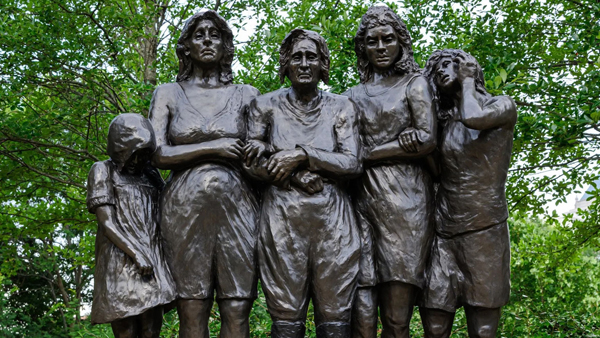
In 2026, Fairfield University and the Fairfield University Art Museum will receive the generous gift of an artwork that embodies the enduring human spirit and serves as a reminder to stand against injustice and promote peace—a bronze Holocaust memorial sculpture titled She Wouldn’t Take Off Her Boots.
She Wouldn’t Take Off Her Boots honors five Jewish women who stood in the face of ultimate terror during the Holocaust and refused to comply. The piece features a bronze camera that faces the women immortalized in metal, symbolizing the Nazi photographer’s lens through which the victims’ last moments were documented.
“The Museum is delighted to accept this monument and to have it take its place among our outdoor sculptures on campus,” said Carey Mack Weber, the museum’s Frank and Clara Meditz Executive Director. “We are looking forward to sharing the educational opportunities this artwork brings with all of our communities—on campus, across Connecticut, and beyond.”
Created by esteemed artist Victoria Milstein, She Wouldn’t Take Off Her Boots was first installed in LeBauer Park in Greensboro, N.C., in April of 2023. There, Fairfield native Paul Burger experienced this work’s profound impact and felt compelled to bring the memorial to his community. His effort led to the founding of Shoah Memorial Fairfield, Connecticut—the nonprofit gifting the sculpture to the University—and to Milstein’s agreement to create a second iteration of the work. An accompanying endowment fund at the University will ensure the memorial’s maintenance and care in perpetuity.
The story behind the sculpture begins on December 15, 1941, near Liepāja, Latvia, when German and Latvian forces murdered 2,749 Jews—mostly women and children—over three days on the beach at Šķēde. According to the Shoah Memorial of Fairfield, Connecticut, website:
“The women were forced to undress before their execution. One among them, Frume Purve, stood defiant, refusing to remove her boots. This quiet yet powerful act of resistance, alongside four others—Sorella Epstein, Roza Epstein, Mia-Malka Epstein, and Emma Epstein—embodied unshakable courage and dignity in the face of certain death. To this day, Frume’s brave act has become a symbol of hope, defiance, and the enduring strength of the human spirit. A Nazi photographer captured these women’s final moments, which formed the basis for the memorial. This photo was preserved by a Jewish worker who risked his life to make a copy.”
“Witnessing how we’ve become numbed to relentless violence—school shootings, political assassinations, and terrorist attacks—this monument urges us to retain our humane sensibilities,” said Special Assistant to the President for Arts and Culture Philip Eliasoph, PhD. “Through her harrowing artistic vision, Victoria Milstein forces our confrontation with unspeakable evil.”
Milstein shared that “as the creator of the monument, I am so grateful to Fairfield University for undertaking this important initiative to further Holocaust education in its community. The monument will be a sacred space for reflection and meditation and enable all visitors to gather together in unity against oppression and persecution. Through the voice of the women in the sculpture She Wouldn’t Take Off Her Boots, Fairfield University will articulate its commitment to fight all forms of hatred, bigotry, and bias.”
Receiving She Wouldn’t Take Off Her Boots supports the University’s efforts to create spaces for interreligious dialogue, and particularly spaces for difficult dialogue to be experienced through a lens of compassion and empathy. A dedicated curriculum for both middle and high school students is connected to the piece, including a self-guided tour and full-length documentary film.
“We’re often reminded by President Nemec—in small classroom settings and large civic places—how the fundamental work in our teaching is to animate the driving spirit of our enduring motto: Per Fidem Ad Plenam Veritatem—Through Faith to the Fullness of Truth,” said Dr. Eliasoph. “As our outdoor sculpture collection on campus expands, it’s encouraging to see that bronze statues honoring pioneering Jesuit saints are being joined with new monuments demonstrating the depth of our sense of faith enhanced with the universality of love.”