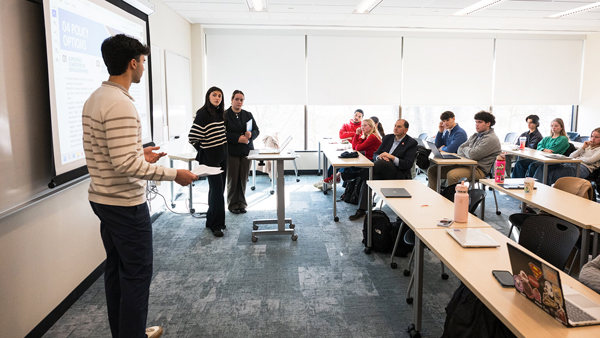
Undergraduate students in the John Charles Meditz College of Arts and Sciences at Fairfield University partnered with the Bridgeport Regional Business Council (BRBC) to develop policy recommendations addressing some of the Greater Bridgeport region’s most pressing economic and infrastructure challenges.
As part of the “State & Local Politics” course taught by Professor Gayle Alberda, PhD, students conducted semester-long research on priority regional issues identified by the BRBC Government Relations Committee. Working in small groups, students produced policy briefs and presented two to three actionable recommendations per topic to Dan Onofrio, president and CEO of the Bridgeport Regional Business Council, at the conclusion of the course.
Students Address Workforce Housing, Transportation, Zoning, and Energy
The BRBC identified seven high-priority policy areas, including workforce and affordable housing, zoning barriers, high-speed rail access, and renewable energy. Each student group examined data, evaluated existing policies, and proposed solutions designed to inform real-world decision-making.
Workforce Housing
One group focused on households earning 60 to 120 percent of the area median income, or up to approximately $148,900 annually. These families often earn too much to qualify for traditional affordable housing yet continue to struggle in the region’s housing market. Students found that Connecticut’s housing shortage has contributed to more than 70,000 unfilled jobs statewide, as workers are unable to live near employment centers.
The group recommended adopting a program similar to the Norwalk Workforce Housing Program, which requires 10 percent of new housing units to be designated as workforce housing. Students also evaluated initiatives such as Good Neighbor Next Door and the Work with RIDE Act.
“The goal is not to push change simply for the sake of change, but to develop practical solutions that support working families, essential workers, and the long-term stability of the Greater Bridgeport region,” said Amauri Rodriguez AA’25, ’27.
High-Speed Rail Access
A second group examined Bridgeport’s exclusion from Acela high-speed rail service, noting that despite the city’s population and redevelopment efforts, it has not experienced benefits such as increased economic activity and higher property values. Students cited Connecticut’s underinvestment in rail infrastructure, compared with states such as Rhode Island, as a contributing factor.
Recommendations included exploring private investment in rail service, reconfiguring seating to improve accessibility, and increasing long-term infrastructure funding.
Regional Housing and Zoning
Another group analyzed the broader regional housing shortage, identifying a need for 6,318 additional housing units. Restrictive zoning in surrounding municipalities has created regional imbalances, leading to rising rents and stagnant wages. With Bridgeport issuing only 15 housing permits in 2023 and facing limited zoning capacity, students proposed streamlining permitting processes, enhancing regional coordination, and offering targeted development incentives.
“I am grateful to the BRBC for giving us this opportunity to learn more about the housing landscape of the Greater Bridgeport area,” said Melody Olivan Sanchez ’26. “I was able to practice analytical and critical thinking skills on a research project that is directly within my neighborhood.”
Renewable Energy
A final group focused on renewable energy, highlighting offshore wind’s estimated $1.2 billion annual economicoutput, while also acknowledging challenges such as high electricity costs and lengthy environmental review timelines. While projects like Revolution Wind offer long-term benefits, students recommended expanding distributed solar and battery storageas faster, more cost-effective options for businesses.
“Working on this project over the semester has helped me gain insight into what is calling for action outside of our campus and the research we conducted was not only engaging, but important for the BRBC and our surrounding community,” said Kathryn Grace Blangiardo ’29.
Community Partnership and Real-World Impact
BRBC leadership praised the collaboration and the students’ work. “After listening to the student presentations, I was genuinely grateful for the collaboration and impressed by the level of detail and research they brought to real challenges impacting businesses across our region, county, and state,” said Onofrio.
The partnership reflects Fairfield University’s commitment to experiential learning, civic engagement, and community-based research, connecting classroom learning with real-world policy challenges facing the region.